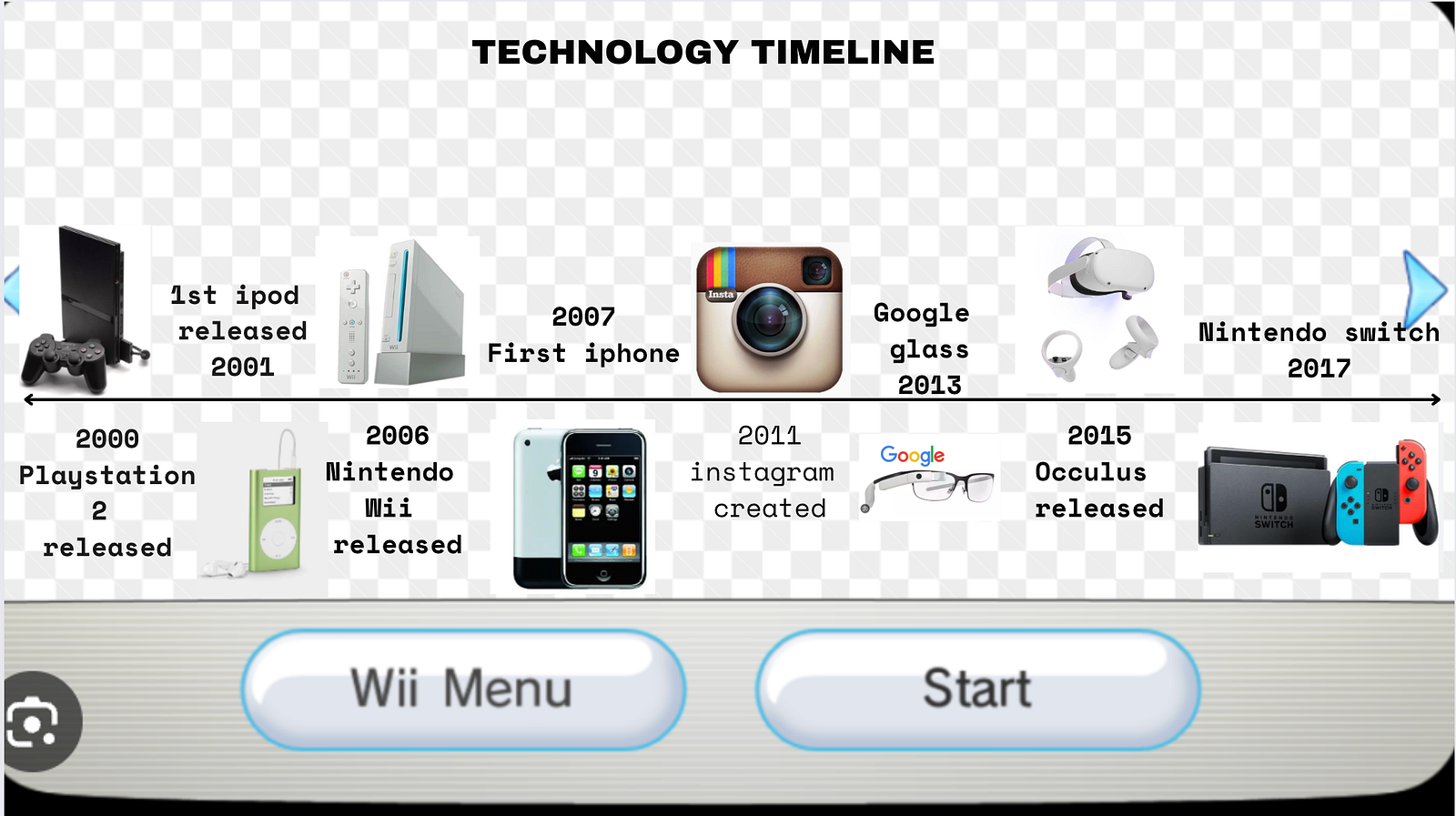
Over the course of my life, I have watched media technologies evolve at a really fast pace, completely changing how people experience entertainment and communication. Growing up alongside these changes has shaped the way I understand and interact with the media today. The timeline I created highlights eight major media technology developments that had a noticeable impact on me and helped form how I view media as both entertainment and a social experience.
The PlayStation 2, originally released in 2001, was the first gaming console I ever owned and had a major influence on me from a young age. Although I didn’t actually get a PS2 until I was around 10 years old, it was my first truly personal experience engaging with video games as a medium. The PS2 helped transform video games into more cinematic and narrative-driven experiences, which made gaming feel just as legitimate and immersive as movies or TV.
The release of the first-generation iPod in 2001 marked a huge shift in how people consumed music. Instead of carrying around CDs or cassette tapes, people could store thousands of songs on a single device. This is how I mostly experienced music when I was growing up, using my brother’s old first generation Ipod.
In 2006, the Nintendo Wii redefined gaming by introducing motion controls that encouraged physical movement and social interaction. I didn’t get one myself, but I got to play it at my friends’ houses and it was the first time I remember adults also enjoying playing video games. It expanded the gaming audience beyond traditional players and turned gaming into something that families and groups could enjoy together in the living room.
Just one year later, the release of the first iPhone in 2007 revolutionized media consumption by combining communication, music, video, internet access, and apps into one device. I basically don’t remember a time before Iphones and they have always been a central part of my development.
The rise of social media is represented by Instagram, created in 2011. Instagram is the social media that I use most often and it has had a major impact on my development. Instagram emphasized visual communication and allowed people to instantly share photos and videos, influencing digital culture, marketing, and personal identity in a way that still shapes media today.
In 2013, Google Glass introduced the idea of wearable media technology by offering hands-free access to information and media. Although it was not widely adopted, it paved the way for future wearable technologies. Google Glass felt like the first time in my life that I saw a futuristic product completely fall short of expectations, failing to deliver the idealized version of the future that new technologies often promise.
Oculus VR, released in 2015, brought virtual reality into the consumer market and offered immersive media experiences that went beyond traditional screens. The Oculus was the first VR experience that actually felt functional and convincing, opening up an entirely new realm of possibilities for media. My neighbor had an Oculus and and i would borrow it often in order to experience new games and experiences through VR.
Finally, the Nintendo Switch, released in 2017, combined home and portable gaming, giving users flexibility in how and where they consume media. It was the first modern game console I used and the first time I was able to use video games as a real form of socialization. Being able to set up my Switch and play with friends in high school regardless of location showed me that gaming could be a social activity and encouraged me to engage more openly in shared media experiences Together, these technologies show how media has become more portable, interactive, immersive, and socially connected
 Site Title
Leave a comment